

In a landmark announcement at the State of Unreal 2026 keynote, Epic Games has officially pulled back the curtain on Lore, an ambitious, in-house-developed version control system (VCS) designed to address the unique bottlenecks inherent in modern digital production. By releasing Lore as an open-source project, Epic is signaling a significant shift in how the industry handles the complex marriage of source code and massive binary assets—a challenge that has long plagued game developers, film studios, and creative agencies.
The State of the Industry: The VCS Impasse
For decades, the software development world has relied on Git as the gold standard for version control. However, Git was architected for source code—text-based files that are easily diffed and merged. Modern game and film production environments operate on a fundamentally different paradigm. Today’s projects are gargantuan, consisting of millions of lines of code intertwined with multi-gigabyte binary assets, high-fidelity textures, 3D meshes, and complex build outputs.
The Git and Perforce Dichotomy
The industry has historically been caught in an uncomfortable compromise between two systems:
- Git (with Git LFS): While Git is the backbone of open-source collaboration, its native handling of binary files is inefficient. Git Large File Storage (LFS) acts as an "add-on" or workaround, essentially storing pointers rather than the files themselves. This creates friction, often leading to fragmented workflows and reliance on external storage providers that don’t integrate seamlessly with the core versioning logic.
- Perforce: For large-scale AAA game development, Perforce has been the de-facto standard. It handles massive binary assets with relative ease compared to Git. However, it is a proprietary, closed-source system that requires a constant, active connection to a central server. This "always-online" requirement stifles developer mobility, prevents true offline productivity, and locks companies into a walled garden where internal tool development is restricted by the vendor’s API.
Epic Games identified that none of the current market solutions effectively bridged the gap between binary-heavy performance, offline flexibility, and an open, developer-friendly ecosystem. Lore was born from the necessity to solve this technical debt.
How Lore Redefines Version Control
Lore is not merely a Git alternative; it is a fundamental reimagining of how data should be tracked across distributed environments.
Architectural Innovation
At its core, Lore is designed to be "binary-native." Unlike legacy systems that treat large files as cumbersome appendages, Lore treats binary data as first-class citizens. Key features of its architecture include:
- Content-Addressable Storage: Every piece of data in Lore is assigned a unique cryptographic fingerprint. If two files—or even two versions of a file—share the same data, that data is stored exactly once. This deduplication significantly reduces storage overhead across branches and repositories.
- Intelligent Chunking: Lore breaks large files into smaller, manageable chunks. If a developer modifies a 10GB file, the system only needs to process and sync the specific chunks that changed, rather than re-uploading the entire asset. This is a game-changer for distributed teams working over limited bandwidth.
- Offline-First Workflow: Unlike Perforce, Lore empowers developers to work entirely offline. Commits, branch switching, and local history tracking occur locally. A server is used only as an "authority" to reconcile conflicts and manage permissions, ensuring that the "source of truth" remains secure without sacrificing the developer’s ability to code on a plane, a remote studio, or a home office.
- Lazy Loading: Lore operates on a demand-based architecture. By default, your machine only holds the files you are actively working on. As you navigate the directory, Lore pulls the necessary data only when it is requested, keeping local storage footprints light and manageable.
The Rust Advantage
Epic Games has built the core library, server, and Command Line Interface (CLI) entirely in Rust. This choice is intentional; Rust’s memory safety and high-performance concurrency provide the speed required for modern, high-throughput media pipelines. Furthermore, Epic is providing official SDKs for JavaScript, Python, C#, and Go. This allows studios to build custom automation tools, dashboard integrations, and internal pipelines that interface directly with the Lore engine, rather than treating the CLI as the only point of entry.
A Chronology of Development
The journey to Lore began within the internal engine teams at Epic Games. As the scale of Fortnite and the Unreal Engine ecosystem grew, the company found that existing workflows were becoming the primary bottleneck for productivity.
- 2024: Internal discussions begin at Epic Games regarding the long-term sustainability of their existing VCS infrastructure. The goal is to create a system that scales with the future of meta-verse-level projects.
- 2025: The "Lore" project moves into a private beta phase within Epic’s internal teams, replacing legacy systems for several core project workflows.
- June 2026 (State of Unreal): Epic Games formally announces the open-source release of Lore. The release is accompanied by a public repository on GitHub, allowing the community to inspect the source, contribute to the SDKs, and begin testing the software in their own production pipelines.
Implications for the Creative Industry
The release of Lore has immediate and far-reaching implications for the software and creative industries. By releasing it as open-source, Epic Games is essentially challenging the monopoly held by proprietary VCS vendors.
Empowering Independent Studios
For smaller indie studios, the cost and complexity of setting up a robust, scalable version control infrastructure have often been prohibitive. By providing a free, open-source tool that mimics the performance of enterprise-grade solutions, Epic is democratizing high-end development workflows. Small teams can now manage massive assets and complex game builds with the same efficiency as a multi-hundred-person studio.

Fostering an Ecosystem of Tools
Because Lore is built with an open-source, interface-centric design, the community is expected to flourish around it. Developers can build GUI clients, web-based management dashboards, and IDE plugins that interact directly with the Lore library. This avoids the "privileged CLI" trap, where tools are forced to "scrape" the output of a command-line interface to work.
Security and Verification
In an era where software supply chain security is paramount, Lore’s built-in verification system is a vital addition. Because every revision is anchored to a unique cryptographic fingerprint, the system can automatically detect tampering or corruption. This ensures the integrity of large-scale assets, which is critical for projects involving sensitive data or collaborative multi-vendor pipelines.
Getting Started: The Road to Stability
It is important to note that Lore is currently in its early stages. With the most recent release at version 0.8.3, Epic Games is transparent about the fact that storage formats and APIs may still evolve. This is a "living" project, and the company is actively inviting feedback from the developer community via their official Discord server and GitHub discussions.
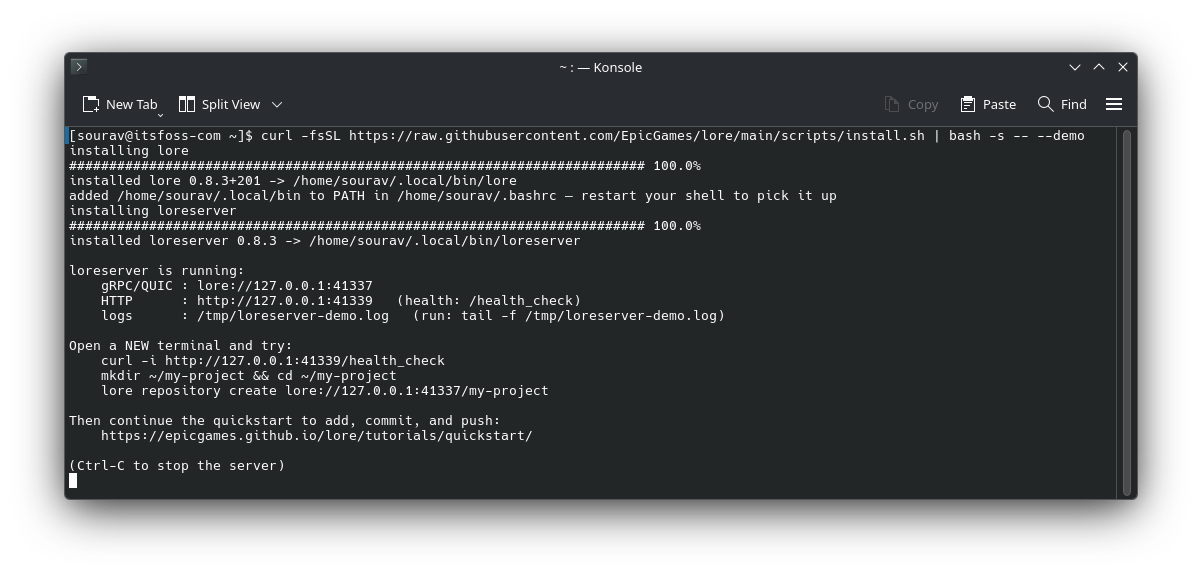
For those eager to experiment, Epic has made the onboarding process remarkably simple. Eschewing complex container setups or dependency hell, the team has provided a single-script installation process. For Linux users, a simple curl command is all that is required to fetch the binaries and initialize a local server instance.
# Example installation process as provided by the Lore team
curl -fsSL https://raw.githubusercontent.com/EpicGames/lore/main/scripts/install.sh | bash -s -- --demo
The Road Ahead: A New Standard?
The release of Lore is a bold move by Epic Games. By open-sourcing a mission-critical tool, they are betting that a collaborative community will help them polish Lore into the definitive standard for binary-heavy version control.
While Git will likely remain the king of source code, Lore is positioning itself to be the engine room for the next generation of digital media. Whether it will successfully displace the deep-rooted influence of Perforce in the AAA space remains to be seen, but the initial reception suggests that the industry is more than ready for a modern, open-source solution.
As Lore moves toward a stable 1.0 release, the question for studios will shift from "What version control should we use?" to "How can we best leverage the Lore ecosystem to accelerate our production?" For now, the tools are in the hands of the community, and the future of version control looks significantly more open, efficient, and robust than it did just a few weeks ago.
